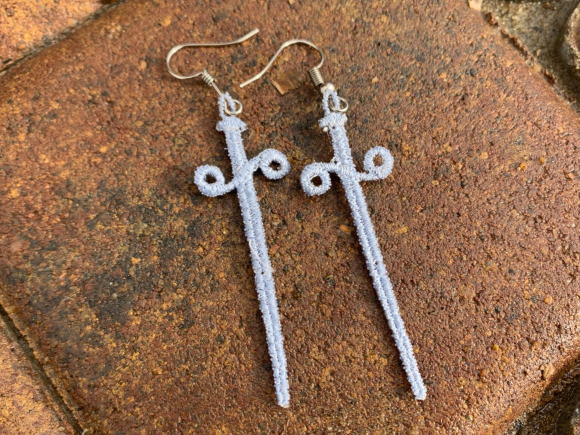
Sword Earrings Embroidery Design
A Gothic Charm That Cuts Through the Ordinary
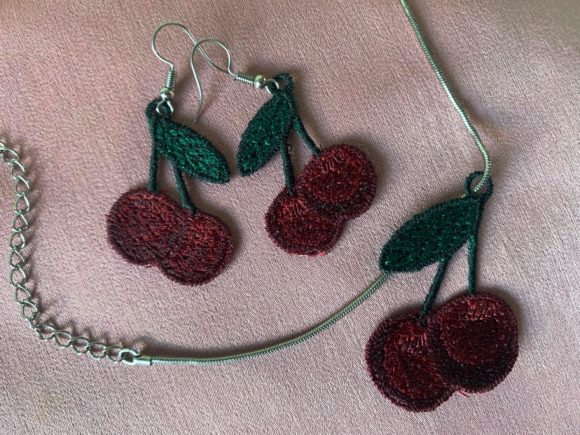
As an embroidery designer who’s stitched over 300 commercial projects—from Etsy bestsellers to boutique apparel lines—I approached Sword Earrings with equal parts curiosity and caution. It’s not just another accessory design; it’s a free-standing lace (FSL) piece that leans hard into mood: sharp, mythic, and unapologetically theatrical. Visually, it reads like a delicate yet decisive symbol—part Viking talisman, part witchy amulet, part egirl edge. The line work is clean but not sterile; there’s subtle tapering in the blade, intentional asymmetry in the hilt, and just enough open lacework to let light pass through without sacrificing structural integrity.
Fits Naturally Into Real-World Projects
Sword Earrings isn’t limited to literal earrings—even though it shines there. I tested it as a standalone motif on a black linen tote bag (medium hoop), a navy cotton sweatshirt cuff, and a cream baby blanket corner. Each time, it elevated the item beyond “cute” into “intentional.” On structured items like aprons or kitchen towels, the FSL sword works beautifully as a top-stitched accent near pockets or hems. On curved surfaces like caps? It held up well when hooped with a medium-density cutaway stabilizer and stitched at reduced speed—but only after confirming the design’s outer dimensions fit comfortably within my cap frame’s active stitching area.
For handmade shops and Etsy sellers, Sword Earrings adds instant narrative value. A single sword charm on a pillow cover signals gothic nursery decor. Stitched onto a denim jacket pocket? Instant cosplay credibility. As a patch, it reads clearly even at 2.5 inches tall—ideal for layered embroidery or mixed-media accessories. And because it’s FSL, it doesn’t require backing fabric to show through; it stands alone, which simplifies finishing for small-batch producers.
What Holds Up—and What Needs Extra Care
Stitch density is moderate—not sparse, not overwhelming. There’s no dense fill stitch flooding the blade; instead, the design relies on satin stitch outlines and strategic running stitch lacing for texture. That means less thread consumption and smoother transitions across fabrics like lightweight cotton, linen blends, and even mid-weight terry cloth. However, I recommend avoiding ultra-stretchy knits (like slub jersey) unless paired with a firm tear-away + cutaway hybrid stabilizer. On dark fabric, contrast matters: white or silver thread pops, but pale gold or charcoal gray adds depth without glare—especially important for product photography.
The smallest details—the crossguard filigree, the tapered tip—are legible at 1.8 inches wide, but anything smaller than 1.5 inches risks losing definition on textured surfaces like toweling or bouclé. For baby blankets or nursery items, I ran a test on organic cotton interlock: the FSL held shape after gentle machine washing, provided I used high-quality polyester thread and trimmed excess lace cleanly post-stitching.
Practical Notes for Commercial Use
- Always test first: Run Sword Earrings on scrap fabric matching your final substrate—especially for curved or uneven surfaces like caps or apron straps.
- Hoop size matters: Check the file’s actual dimensions before loading. Some versions of this design span 3.2" x 1.4"—tight for small hoops but perfect for standard 4x4 or larger.
- Stabilizer strategy: For FSL, use water-soluble topping *plus* medium-cutaway backing. Skip the topping on dark fabrics if thread coverage is full; add it back for light threads on black fabric to prevent shadowing.
- Thread color testing: Try three options side-by-side: stark white, warm antique gold, and deep charcoal. Lighting changes everything—what looks dramatic in studio light may read muddy in natural window light.
- Inspect after stitching: Gently stretch the FSL piece while damp—check for skipped stitches near tight curves or tiny anchor points. Reinforce weak spots with hand-tied knots if needed before rinsing.
- Licensing check: Before listing finished goods on Etsy or wholesale platforms, confirm the Creative Fabrica embroidery license permits commercial use of Sword Earrings for physical products. Some FSL files include usage limits for resale—verify before scaling.
How Sword Earrings Elevates Your Handmade Brand
This isn’t just about aesthetics—it’s about perception. Customers scrolling through a crowded handmade shop don’t pause for generic florals. They stop for symbols with attitude. Sword Earrings delivers that. When stitched cleanly on a custom apron for a local apothecary, it communicated craftsmanship *and* character in one glance. On a printable mockup for an Etsy listing, it added authenticity—no stock vectors, no flat graphics, just real embroidery texture you can almost feel through the screen.
For creative entrepreneurs building a cohesive line—say, gothic home goods or myth-inspired apparel—Sword Earrings functions as a versatile design asset. Pair it with runes, ravens, or minimalist moons, and you’ve got a scalable visual language. It also photographs exceptionally well: the lace catches light, the edges stay crisp, and the shape reads clearly even in thumbnail size.
Final Verdict for Real Project Use
If you’re evaluating Sword Earrings for a customer order, seasonal gift line, or boutique merchandise drop—yes, it’s worth downloading. It’s not a “set-and-forget” design, but it’s not finicky either. With thoughtful stabilizing, thread selection, and a quick test run, it delivers professional results across apparel, accessories, and home textiles. It performs especially well where personality matters more than polish: cosplay gear, indie merch, handmade gifts, and curated Etsy collections.
Just remember: Sword Earrings earns its impact through intention—not just placement, but context. Stitch it where it tells a story. Use it where your audience already leans into legend. And always, always treat it like the small-but-mighty embroidery file it is: compact in size, rich in mood, and quietly powerful in execution.